

Secondary
Table of contents
General Information
The Secondary School Cycle is divided in three sub-cycles:
▪ Observation Cycle (S1-S3)
▪ Pre-Orientation Cycle (S4-S5)
▪ Orientation Cycle or European Baccalaureate cycle (S6-S7)
Observation Cycle (S1-S3)
| Subjects | S1 | S2 | S3 |
|---|---|---|---|
| L1 : French / English | 5 | 5 | 4 |
| Mathematics | 4 | 4 | 4 |
| L2 : English / French | 5 | 4 | 4 |
| L3: Dutch, Spanish, Italian, German, Swedish | 2 | 3 | 3 |
| Physical education | 4 | 4 | 4 |
| Ethics or religion | 2 | 2 | 2 |
| Human sciences | 3 | 3 | 3 |
| Integrated science | 4 | 4 | 4 |
| Latin | 2 | 2 | 2 |
| Art | 2 | 2 | 2 |
| Music | 2 | 2 | 2 |
| European Hours : ICT / Woodwork | 2 | 2 | 2 |
| Total | 37 | 37 | 36 |
| Free periods / Workshops | 0 | 0 | 1 |
From S1, ethics / religion classes are taught in L2. From S3, human sciences classes are also taught in L2.
Pre-orientation Cycle (S4-S5)
The pre-orientation cycle includes compulsory subjects and options. Students take 29 periods of compulsory subjects, plus options.
| Compulsory subjects | Periods |
|---|---|
| L1 : French / English | 4 |
| Mathematics (basic or advanced) | 6 |
| L2 : English / French | 3 |
| L3 : Dutch, Spanish, Italian, German | 3 |
| Physical education | 2 |
| Ethics / Religion (L2) | 1 |
| History (L2) | 2 |
| Geography (L2) | 2 |
| Physics | 2 |
| Chemistry | 2 |
| Biology | 2 |
| Total number of periods (compulsory subjects) | 29 |
| Options | Periods |
|---|---|
| * L4 Spanish, L4 Dutch / Latin / Economics | 4 |
| ** Art / Music / ICT / Ancient Greek | 2 |
| Total number of periods | 35 |
| Free periods | 2 |
Complete programme:
* Choose one of the three options: L4, economics or Latin.
** Choose one of the four options: art, music, ICT or ancient Greek.
The following subjects are taught in the second language (L2): geography, history, ethics or religion. Core mathematics and economics are taught in mixed languages (FR & EN).
Orientation Cycle – Baccalaureate
Students in the final cycle can choose between :
- The International Baccalaureate Diploma Programme (IBDP1 & IBDP2)
- The European Baccalaureate program (in French and in English: S6 and S7)
Each of these diplomas grants access to higher education and universities in Belgium and abroad.
The International Baccalaureate® (IB) Diploma Programme (DP) is for students aged 16-19.
The Diploma Programme curriculum is made up of 6 subject groups and 3 core elements (+ physical education). The programme is taught in English.
IB1 – IB2 : International Baccalaureate subject choices
Choose 6 subjects, one from each Group 1 to 5. The 6th subject is a free choice. You need 3 Higher Level (HL) courses.
| Group | Subject | Levels available |
|---|---|---|
| Group 1 | English | SL, HL |
| Group 2 | French | SL, HL |
| Group 3 | Psychology | SL, HL |
| Group 3 | Business | SL, HL |
| Group 4 | ESS | SL |
| Group 4 | Biology | SL, HL |
| Group 5 | Math AI | SL |
| Group 6* | Art | SL |
| Group | Subject | Levels available |
|---|---|---|
| Group 1 | English | SL, HL |
| Group 2 | French | SL, HL |
| Group 3 | ESS | SL |
| Group 4 | Physics | SL, HL |
| Group 4 | Chemistry | SL, HL |
| Group 4 | Biology | SL, HL |
| Group 5 | Math AA | SL, HL |
| Subject 7 | Chemistry | SL, HL** |
Core subjects (both tracks)
- Theory of Knowledge
- Creativity – Activity – Service
- Extended Essay
- Physical Education
Levels: SL (Standard Level) = 3 periods/week. HL (Higher Level) = 5 periods/week.
* 6th subject, free choice.
** If you need chemistry as a 7th subject for university entrance, please contact the Secondary secretariat.
The European Baccalaureate cycle covers the last two years of secondary education (S6 and S7).
S6-S7
| Subject | Choice | Periods |
|---|---|---|
| Language 1 | English | 4 |
| French | ||
| Language 2 | English | 3 |
| French | ||
| Math | Math 3 | 3 |
| Math 5 | 5 | |
| Mandatory | STS | 2 |
| History | 2 | |
| Geography | 2 | |
| Ethics | 1 | |
| Philosophy | 2 | |
| PE | 2 | |
| Total periods | 21/23 |
| Option | Choice | Periods |
|---|---|---|
| Option 1 | Physics | 4 |
| L3 Spanish | 4 | |
| L3 Dutch | ||
| L3 German | ||
| L3 Italian | ||
| Swedish | 3 | |
| Option 2 | Chemistry | 4 |
| L4 Dutch | 4 | |
| L4 Spanish | ||
| Economy | 4 | |
| Option 3 | Biology | 4 |
| Category | Choice | Periods |
|---|---|---|
| Complementary subjects | L5 Italian | 2 |
| L5 German | 2 | |
| Art | 2 | |
| Music | 2 |
- Only one choice per option can be chosen.
- 1 option can be dropped if the total of periods reached is 31.
- STS can be dropped if at least one science is chosen and 31 periods are reached.
- You need approval from the Deputy Head to go over 35 periods.
After secondary school: Another path to University
For students looking for an alternative after their secondary school, or an additional pathway into English-speaking universities, the University Foundation Centre (Waterloo) offers the

FORCES: Multilingual secondary school and support services
Multilingual environment
Pupils at our multilingual secondary school are exposed to several languages at once, and their learning builds up gradually over the years, culminating in a trilingual – or even quadrilingual – programme at secondary level.
Academic Support
Different forms and levels of support are offered, aimed at providing appropriate assistance to students facing difficulties and having special educational needs at any point in their academic journey, enabling them to develop and progress according to their potential.
An outstanding learning environment
The castle, school buildings, and outdoor facilities are surrounded by expansive parkland, providing a safe and peaceful environment. Our main building houses three science laboratories and consists of classrooms equipped with interactive whiteboards. A library is also accessible to everyone.
CHARACTERISTICS : DEVELOPMENT AND PREPARATION
Safe and nurturing environment
which supports active learning for each child in a demanding yet stimulating manner.
Personal development
We consider each student as an individual and track and encourage their personal development.
Preparation for higher education
Students have the opportunity to prepare for university entrance exams, whether they are Belgian or foreign, through specialized courses.
Eco-label
The school is EcoSchool certified, which means it actively engages in ecological practices aimed at preparing students for the major challenges of tomorrow. We offer our students the opportunity to experiment with their learning in a real "living lab."
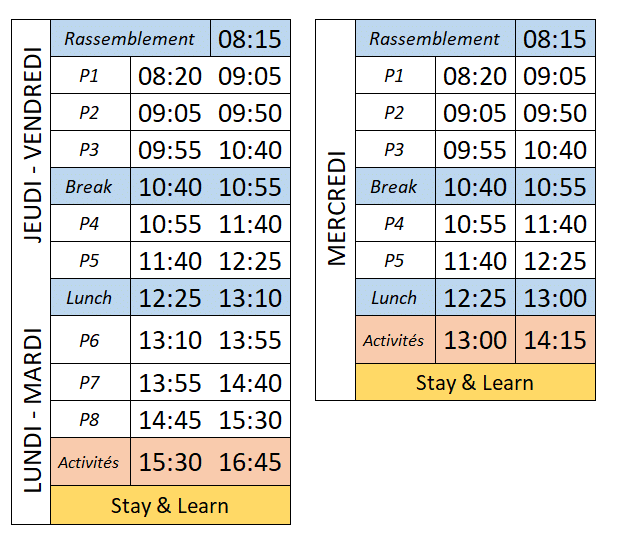
Schedule


Competences
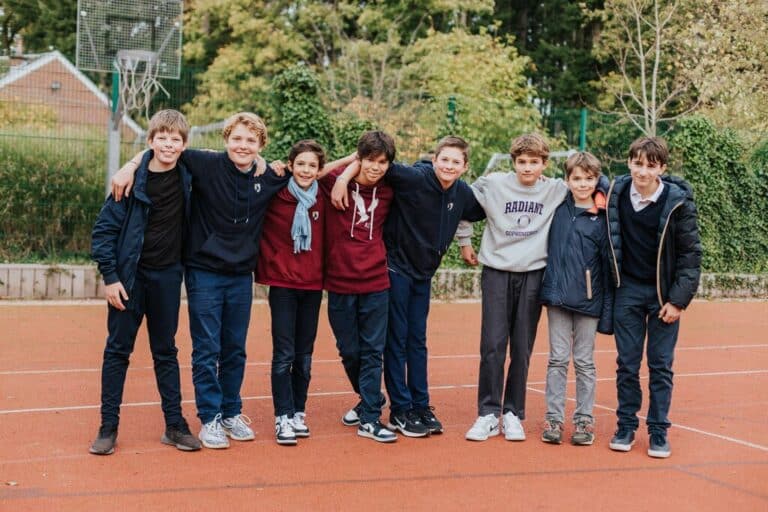
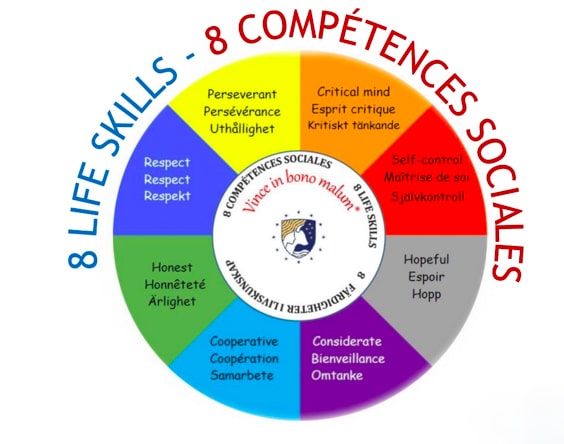
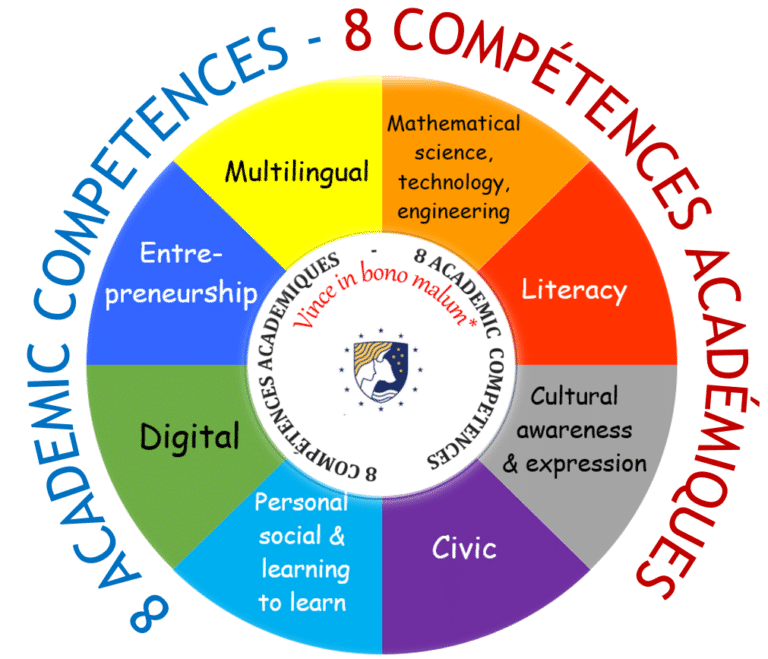
- At school, we don’t just learn to read, write and do maths: we also learn to live together, respecting fundamental values that allow everyone to develop and grow in peace.
- We seek a balance between academic skills and social skills.
School Uniform
- The purpose of our school uniform policy is to create a cohesive, respectful, and focused learning environment where students can concentrate on their education.
- The policy encourages students to take pride in their school community.
- A school uniform is required for all primary and secondary school students, following specific styles and colors.
- Specific EEBA clothing is available for purchase through the online store.
- On Fridays, students may dress casually while adhering to some requirements.